


The level of insulation present in the construction directly affects how much it costs to heat a building, but continuity is also important. In an existing building, a thermal imaging camera survey can show which areas of the building are losing most heat and therefore would benefit from improved insulation. Often it reveals defects where insulation is missing, where cold air is seeping in, or there are faults concealed within the construction that cannot be easily identified by any other method.
A thermal imaging camera survey is useful for:
- Clients considering upgrading the insulation level of an existing building, on the external or internal surface of the walls as well as adding it in the loft, suspended floors and other locations.
- Identifying areas where there are gaps in the insulation leading to heat loss, cold spots and condensation.
- New buildings where a check is needed to ensure that insulation has been installed correctly.

How A Thermal Imaging Camera Survey Works
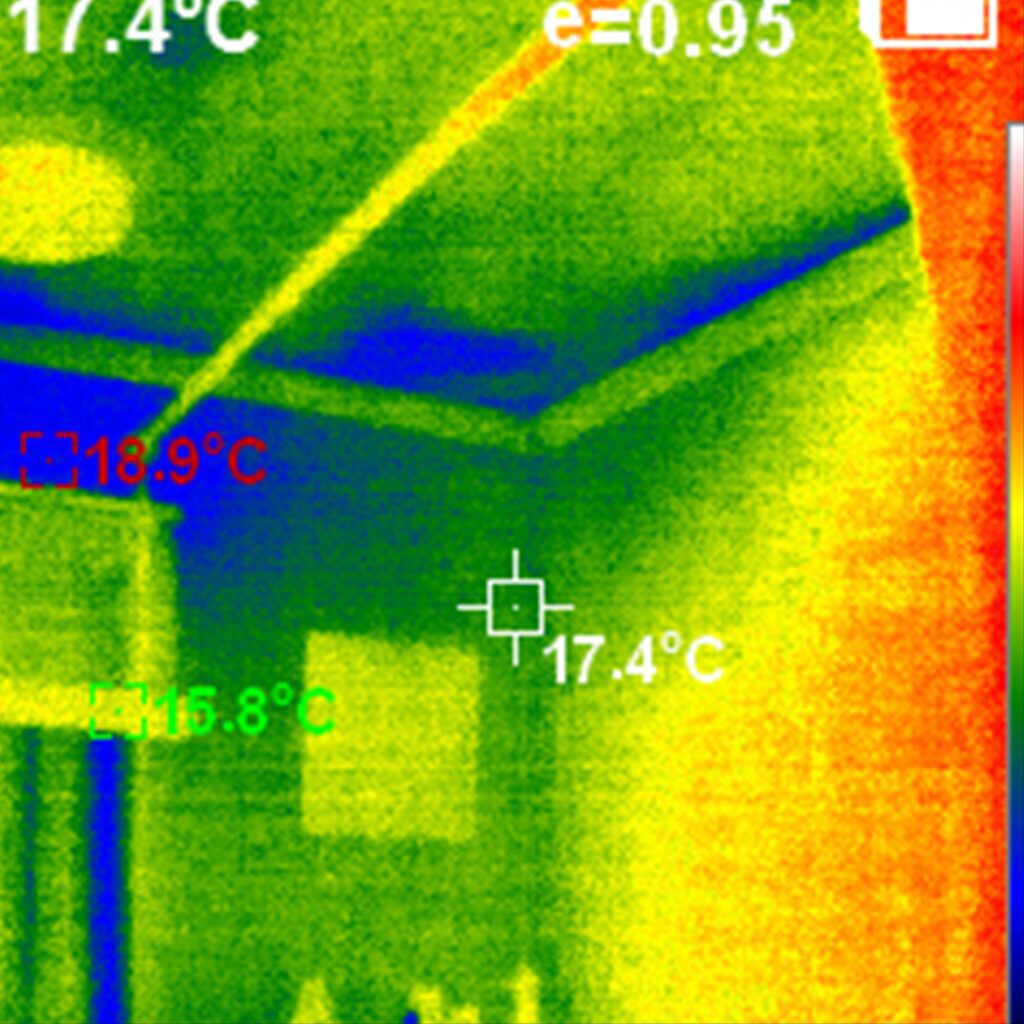
The camera measures the surface temperatures of the building fabric and produces images that indicate the relative heat loss through the construction walls, roof, floors, openings etc. The colours show the range of temperatures between the hottest and coolest points in the image. The images show relative temperatures between different parts of the building at the time of the survey and readings cannot be compared directly with other buildings surveyed at other times or locations.
For images of the outside of the building, the redder end of the spectrum indicates more heat being lost through the roof, windows and walls. Typically, this is because the wall is less well insulated and heat is passing more easily through the fabric, resulting in a warmer external surface. The blue/green end of the spectrum suggests that the construction is better insulated, reducing heat loss resulting in a cooler surface.
For images taken inside the building, red indicates that the temperature of a surface is relatively warm, with less heat flowing through to the outside. Blue/green colours are recorded where the surface is cooler, usually because less insulation is present.
The camera’s strongest feature is that it highlights differences in temperature within the construction, indicating where the insulation levels are inconsistent, and which elements of the building are losing most heat. A very even colour, with only minor variations indicates that the construction is consistent, whether or not it is thermally efficient.
Note: Infra-red radiation cannot pass through glass so will not violate privacy of occupants.

Potential Faults that the Camera Can Identify
The camera will highlight variations in temperature that cannot be explained by known features of the building, such as water pipes, or typical construction details, such as slightly lower temperatures at wall/floor junctions and around openings. The camera can also pick up;
- Inconsistent insulation in walls and floors.
- Poorly installed or sealed doors.
- Incorrectly installed draughty windows.
- Air movement behind dry lining.
- Missing or disrupted insulation around ceiling mounted downlighters.
- Absent or poorly installed insulation at the ceiling and gable wall junction.
- Inadequate insulation at the junction of the ceiling and external walls.
- Insulation issues in dormer windows.
- Irregular underfloor heating pipework.



Survey Conditions
The ideal conditions for survey occur during mid autumn, winter and early spring. This is because there has to be sufficient difference between the heated inside of the building and the external air temperature – at least 10 to 15 degrees C, with the outside less than 5 degrees C. The survey should preferably be carried out more than 24 hours after any rain. Ideally there should be no bright sunshine because the building materials can absorb the sun’s heat and give misleading readings. Night time readings can be taken particularly if house not occupied during the day and the heating system needs to be run for several hours to ensure reliable readings can be taken. If a re-inspection is carried out after any remedial work has been completed it should be under in similar conditions to initial survey.
If you would like to organise a thermal survey please feel free to call us on 0115 922 9831, or email enquiries@julianowen.co.uk
If you are interested in improving the energy efficiency of your home see our eco retrofit case study discussing the process of upgrading and refurbishing a property in Nottingham.
